Fixture Congestion Tests Squad Resilience Across European Leagues
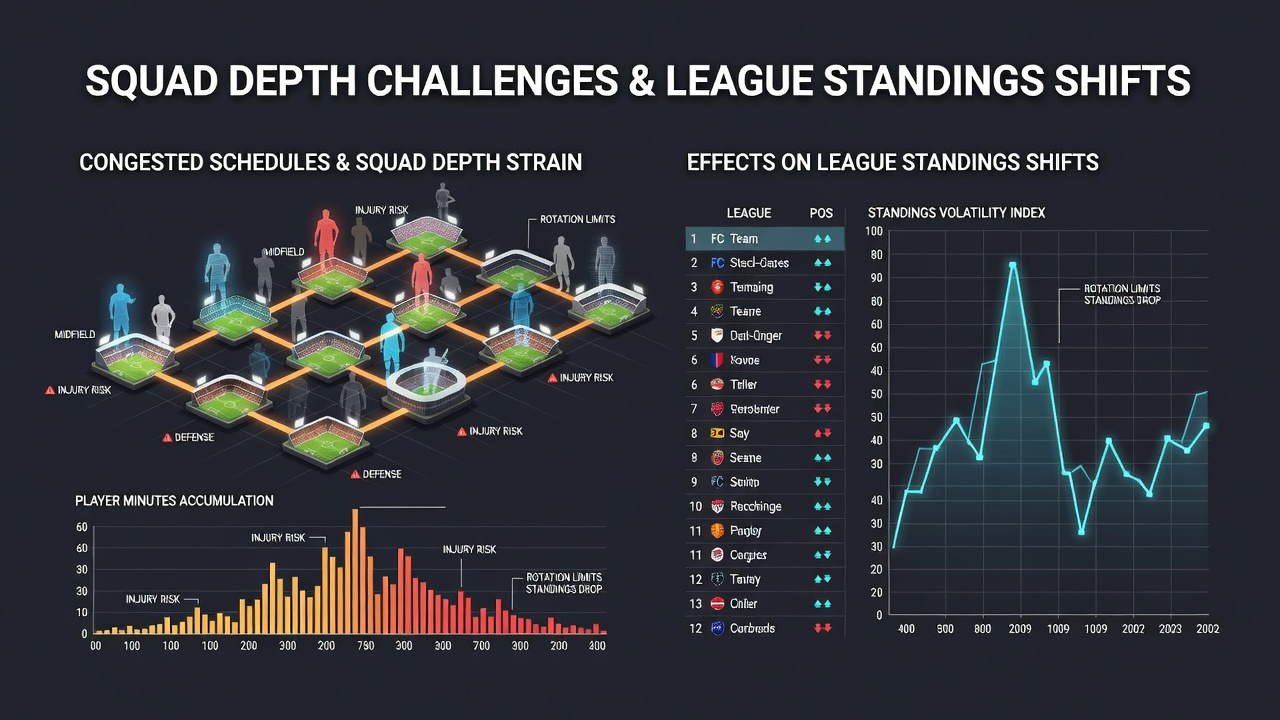
European football calendars pack multiple competitions into short windows, and teams with shallow squads often see results slide when matches pile up. Data from domestic leagues shows that clubs competing in domestic cups alongside continental ties record higher rates of player absences, and those absences correlate with points dropped in league fixtures. Researchers tracking workload metrics across the 2024/25 and 2025/26 seasons found that teams averaging more than one match every four days experienced measurable drops in high-intensity running output after the sixth consecutive week of congestion.
Defining Congested Periods and Their Frequency
Leagues without a winter shutdown, such as the English Championship and Serie A, schedule three matches in eight days on several occasions each season, whereas the Bundesliga and La Liga insert brief pauses yet still face similar clusters during cup runs. UEFA competitions add another layer because knockout ties often fall midweek, forcing clubs to travel across time zones before returning to domestic duty. Observers note that the 2025/26 campaign included an extended international break in March followed immediately by a run of four league games in fourteen days for several clubs, creating a recovery deficit that persisted into April.
How Limited Squad Depth Amplifies Fatigue
Squad depth refers to the number of players capable of performing at a comparable level when starters rest or suffer injury. Teams relying on fewer than eighteen match-ready outfield players encounter rotation problems once the fixture list tightens. Medical staff at clubs with smaller budgets report that substitute options often carry higher injury risk because they receive fewer minutes during less congested phases and therefore lack match sharpness. Studies conducted by sports-science departments at universities in Germany and Australia indicate that players logging more than 350 minutes across a fourteen-day period show elevated creatine-kinase levels, a marker of muscle damage, which in turn lengthens recovery windows.
Case Examples from Recent Campaigns
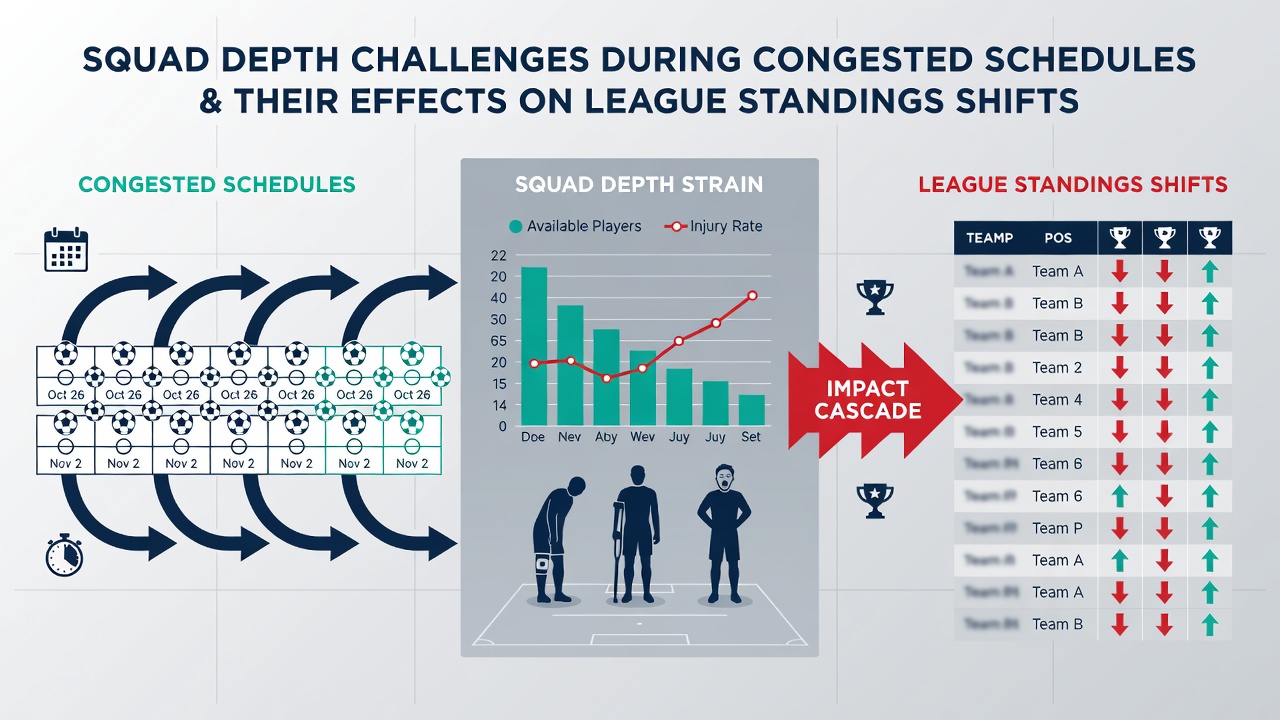
One mid-table side in the 2024/25 Bundesliga lost three central defenders to hamstring strains during a December cluster of five matches in sixteen days; the club subsequently collected only four points from the next six league fixtures and slipped four places in the table. In contrast, a top-six side in Ligue 1 maintained a 22-player rotation group and avoided similar injury spikes, finishing the same period with ten points from six matches. Data compiled by league statisticians shows that clubs finishing in the bottom half of their respective tables averaged 2.3 fewer available senior players per match during peak congestion windows than clubs finishing in the top four.
Measurable Shifts in League Standings
Points accumulated during congested blocks account for roughly 28 percent of a season’s total in most major leagues, according to season-long performance audits. When a club drops points in those windows, the deficit often proves difficult to recover because later fixtures rarely offer compensatory double-game weeks. League tables compiled after the 2025/26 winter period revealed that six of the ten teams that lost the most ground between December and February had used the same starting eleven in at least 60 percent of congested matches. Conversely, sides that rotated at least four positions across those same blocks gained an average of three places by the end of April.
Strategic Responses Observed Across Leagues
Clubs address depth limitations through targeted January signings, loan arrangements, and integration of academy prospects. Several Serie A sides in 2025/26 expanded their registered squads to twenty-five players by the winter window, allowing coaches to rest key midfielders without dropping below competitive thresholds. Training-load management programs, including GPS monitoring and individualized recovery protocols, have become standard at clubs that reached the later stages of both domestic and European competitions. Analysts tracking these interventions report that teams employing structured rotation reduced soft-tissue injuries by 17 percent compared with the prior season when similar fixture density occurred.
Longer-Term Patterns Through June 2026
By June 2026, performance databases covering five consecutive seasons will allow clubs to model expected points loss based on fixture density and squad size. Pre-season planning meetings already incorporate these models when deciding squad composition for the following campaign. National associations continue to examine calendar reforms, yet the addition of expanded continental tournaments maintains pressure on squad resources. Teams that invested early in depth during the 2025 summer window entered the final stretch of the 2025/26 season with fewer forced changes and steadier league positions.
Conclusion
Fixture congestion exposes the gap between first-team quality and overall squad capacity, and those gaps translate directly into points totals that determine final league positions. Clubs maintaining broader, better-conditioned squads navigate these periods with smaller disruptions to results, while those lacking equivalent resources experience steeper climbs back up the standings once the schedule eases. Continued monitoring of workload data and injury trends through 2026 will refine how teams prepare for future calendar clusters.