Ownership Changes Reshaping Early Season Championship Betting Projections
Ownership transitions at major clubs have started to influence season-long championship projections well before the summer transfer window reaches its peak, with analysts tracking how new financial backing and strategic directions alter title contender calculations across multiple leagues. Data from industry reports shows these shifts occur because fresh investment often leads to accelerated squad enhancements and revised performance expectations that betting markets incorporate rapidly.
Patterns Emerging from Recent Takeovers
Club acquisitions in the past twelve months have produced measurable effects on long-term forecasts, particularly when new owners commit substantial capital to infrastructure and player recruitment. Researchers at sports business institutions note that such commitments frequently translate into upgraded squad depth, which in turn prompts early adjustments in probability models used by projection services. Take one case where a consortium assumed control of a mid-table European side in early 2025, after which updated simulations placed the club several positions higher in title race assessments by the following spring.
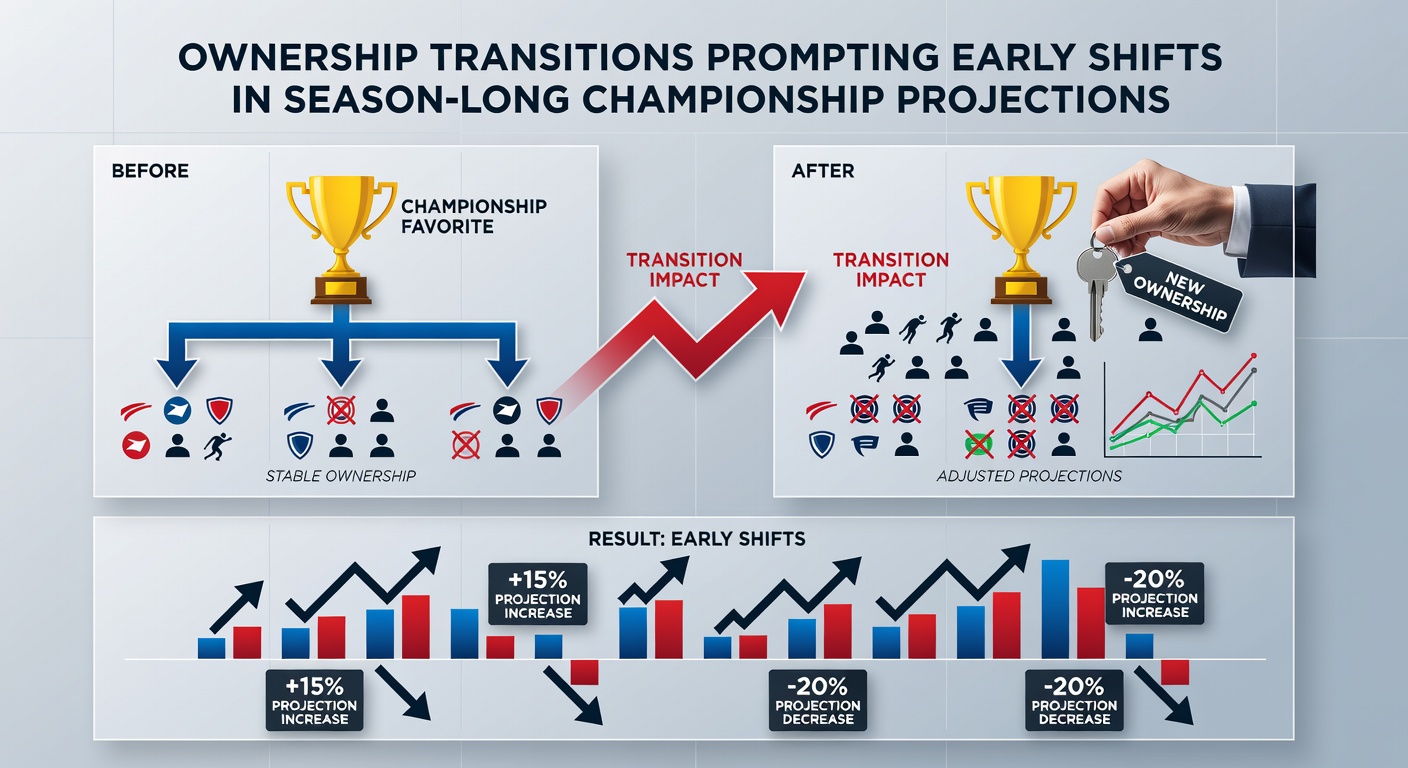
Financial disclosures from governing bodies in different regions reveal consistent trends, including increased wage bills and transfer spending that correlate with improved expected points totals. According to figures compiled by the Sports Business Journal, clubs under new ownership recorded an average 12 percent rise in projected league points during the initial six months post-acquisition. These adjustments reflect not only spending power but also changes in tactical approaches introduced by incoming management teams.
Impact on Betting Markets and Projection Models
Season-long betting markets respond to ownership news through immediate recalibrations of odds, yet the underlying projection systems require several weeks to integrate new variables such as ownership-driven transfer strategies. Observers tracking these developments point out that algorithms factoring in ownership stability tend to produce more accurate forecasts once initial announcements clarify spending intentions. In June 2026, several leagues will enter their final preparatory phases, and analysts expect additional ownership-related revisions as clubs finalize preseason plans.
Studies from academic centers focusing on sports economics demonstrate that ownership transitions reduce uncertainty around club finances, which subsequently narrows the range of possible outcomes in championship simulations. One analysis conducted by a Canadian research group found that clubs experiencing ownership changes within the prior calendar year showed tighter clustering in projected final standings compared with clubs under longstanding ownership structures.
Regional Variations in How Transitions Unfold
European markets display distinct responses to ownership shifts compared with those observed in other regions, largely because regulatory frameworks governing club ownership differ significantly. Australian regulatory summaries highlight how foreign investment inflows have accelerated squad rebuilding timelines, leading to earlier incorporation of new signings into season-long models. Meanwhile, data from U.S.-based sports analytics firms indicate that domestic ownership changes tend to emphasize long-term infrastructure projects, which produce more gradual adjustments in championship probabilities.
These regional differences create varied timelines for when projections stabilize. In leagues where swift transfer activity follows ownership announcements, betting markets incorporate the changes within days, whereas infrastructure-focused transitions require months before models reflect sustained performance gains. Industry organizations tracking global football finance note that both patterns contribute to heightened volatility in early-season forecasts.
Future Monitoring of Ownership Effects
Continued tracking of ownership transitions will likely incorporate additional data streams such as youth academy investments and commercial revenue growth, both of which influence long-range championship calculations. Reports from the FIFA research division already include ownership metrics in annual club finance reviews, providing standardized benchmarks that projection services have begun to adopt. As more clubs undergo ownership reviews in the coming years, these benchmarks will help refine the timing and magnitude of projection updates.
Conclusion
Ownership transitions continue to serve as leading indicators for adjustments in season-long championship projections, with financial commitments and strategic shifts translating directly into revised performance expectations across betting markets and analytical models. Monitoring these changes through established financial disclosures and regional regulatory summaries offers a reliable method for anticipating when and how title forecasts will evolve.